
Sump pump and battery planning in Rochester
Basement Waterproofing in Rochester, NY can depend on how collected water leaves the house. Rochester Basement Waterproofing Pros discusses the basin, pump, discharge piping and power arrangements as connected parts. Battery support can be considered separately, with its capacity and maintenance explained rather than assumed.
Collection is only the beginning
A basin receives water from the collection route serving it. The pump then moves that water through discharge piping. The basin, pump and outlet need to be considered together, including how water reaches the pit and where the outlet can appropriately end.
An existing pump is not proof that the basement has a complete collection path. Likewise, a new floor-edge drain does not decide what equipment should move the collected water. During an assessment, ask which existing parts can be retained, which are proposed for change and how the arrangement will be checked once work is complete.
The outlet belongs in the conversation
A discharge route should be described in practical terms, including its path from the basin and the intended outlet. Cold-weather exposure and a route that returns water toward the foundation deserve attention. Do not assume an outlet is acceptable because another house uses one.
Monroe County guidance distinguishes stormwater management from sanitary sewer connections. The City of Rochester also has combined sewer conditions in parts of its system, which is a reason to ask rather than generalize. For any proposed discharge arrangement, confirm with your town or Monroe County. This page does not authorize a connection.
Power support with stated limits
Battery support is an additional system decision, not a promise of operation through every outage. The battery condition, pump demand and configuration affect how long support can continue. Ask how capacity is considered and how the equipment signals that attention is needed.
An alarm and a pump have separate roles. An alarm can indicate a condition but cannot move water by itself. The proposal should explain which equipment is included, what needs power and what maintenance is expected. If existing equipment remains in place, ask how the proposed support arrangement relates to it.
Access after installation
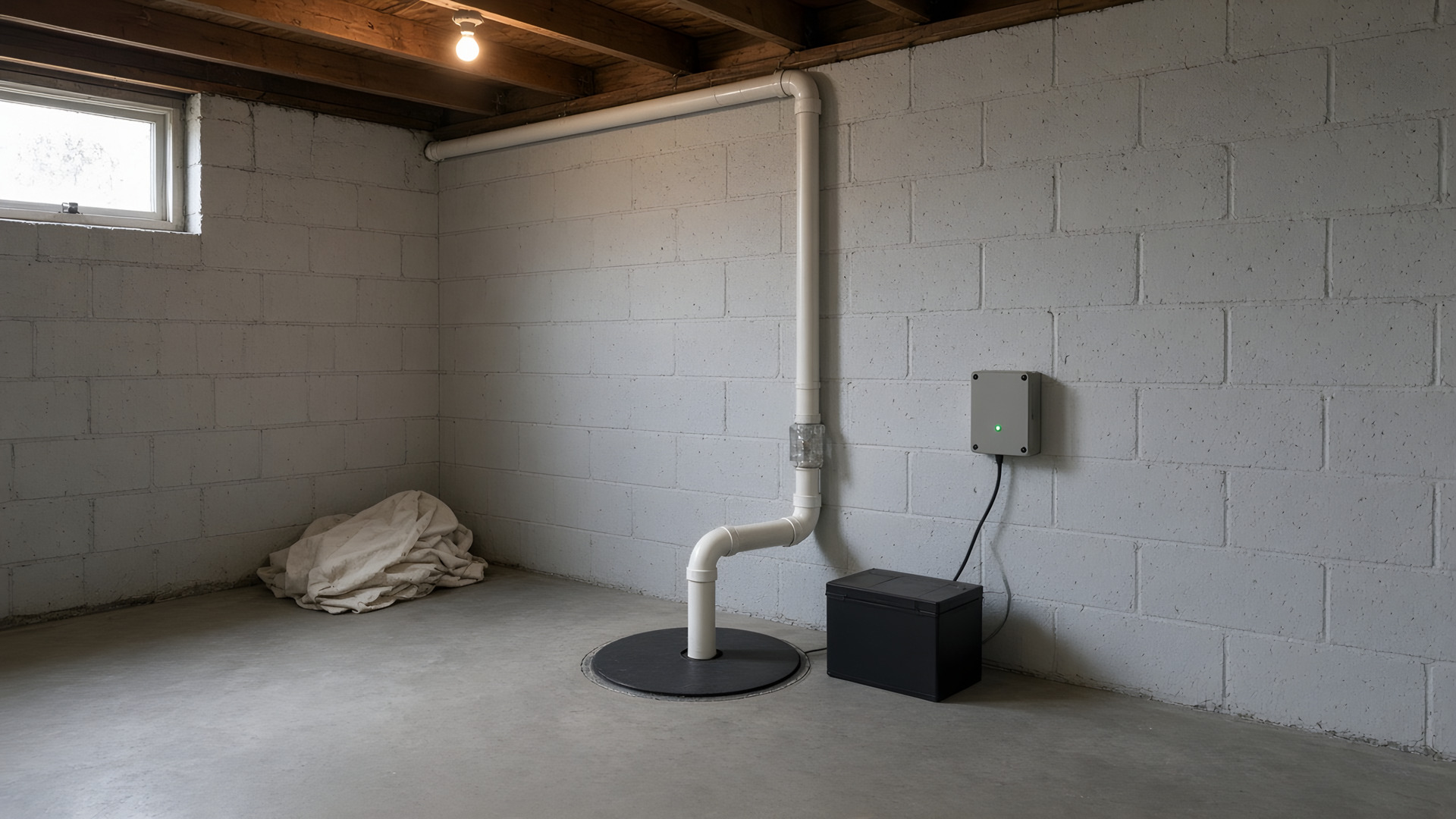
The basin cover, service points and relevant equipment need to remain accessible for checks and maintenance. The supplied image shows a covered basin, discharge piping and a battery box; it does not establish the layout required at another house.
Discuss how operation will be demonstrated and what routine attention the selected equipment needs. Keep the written equipment information with the scope. A pump that has not been checked can leave uncertainty even when the basement is dry at the time of a visit. Tell the assessor about unusual cycling, sounds or visible water patterns without attempting electrical work.
Equipment is one part of the scope
A basin change, discharge routing, access through finished surfaces and power arrangements can affect the proposed work as well as the pump itself. A meaningful written quote distinguishes the equipment from installation and any connected drainage work.
Rochester Basement Waterproofing Pros can discuss the existing arrangement and the observations that prompted your call. Tell us whether there is a basin, whether water reaches it and what you know about the outlet. Call to check availability. Use the perimeter collection page to compare the route into the pit with the equipment that moves water out.
Related Folio Reading
Bring the pattern to the conversation
Tell Rochester Basement Waterproofing Pros where water first appears and when it returns. You can discuss the basement layout, existing equipment and an assessment without choosing a method in advance. Call to check availability.
Calls answered directly. Discuss water patterns, access and next steps for your house.